AI Search Visibility
LLM SEO Australia: How to Improve Your Visibility in AI Search
LLM SEO makes your business information easier for AI search systems to find, understand and reference. Start with accessible pages, clear answers to customer questions and verifiable evidence, then measure mentions and citations using repeatable tests.
Direct answer
Short answer
LLM SEO makes your business information easier for AI search systems to find, understand and reference. Start with accessible pages, clear answers to customer questions and verifiable evidence, then measure mentions and citations using repeatable tests.
- Evidence sections
- 6
- Focused sections that develop the answer.
- Implementation actions
- 5
- Practical actions readers can apply.
- Measurement signals
- 4
- Signals used to evaluate progress.
Key takeaways
What matters before you act
Use these points as the decision summary for the article.
- 01SEO and LLM SEO share foundations: accessible pages, useful content and credible evidence.
- 02Use website structure, content format and information authority as a review framework, not a ranking formula.
- 03Provide real Australian context, including service coverage, local evidence and relevant pricing details.
- 04Track mentions and citations with a consistent prompt set, and report measurement limitations.
Why SEO matters in the LLM era
During our research into GEO, I gradually came to realise the importance of SEO. This led us to today's question: why has SEO become more important than ever in the LLM era, and why do I believe every Australian SME should start as soon as possible?
SEO, or search engine optimisation, uses technical methods to help search engines such as Google Search and Bing find and understand your business faster and more accurately. Now that we know what SEO is, what is LLM SEO?
LLM SEO is the process of making a business, its website and its information easier for large language models and AI search systems to understand, trust and reference in generated answers.
What Is the Difference Between LLM SEO and SEO?
Traditional SEO focuses on visibility in search results. LLM SEO and generative engine optimisation (GEO) are overlapping terms for improving visibility in AI-generated answers. Answer engine optimisation (AEO) also covers direct-answer experiences, including those outside large language models. These are overlapping practices rather than separate technical standards.
From our perspective, however, SEO, LLM SEO and GEO can work together. This is why our company connects every part of digital marketing, using consistency and compatibility across multiple formats to achieve better results.
| Traditional SEO | LLM SEO |
|---|---|
| Competes for rankings in search results | Competes to be mentioned or cited in AI-generated answers |
| Primarily optimises web pages and links | Also optimises brand entities, content clarity and verifiability |
| Focuses on clicks and organic traffic | Also focuses on AI mentions, citations and recommendations |
| Centres on keywords and search intent | Places greater emphasis on specific questions, answers and information relationships |
How Does AI Search Decide What to Mention?
When discussing what GEO is, although we have already explained the differences and similarities between SEO and GEO, the biggest question for business owners is still how to make GEO effective.
We use three practical areas to organise an LLM SEO review: website structure, content format and information authority. They help identify improvements; they are not a published AI ranking formula.
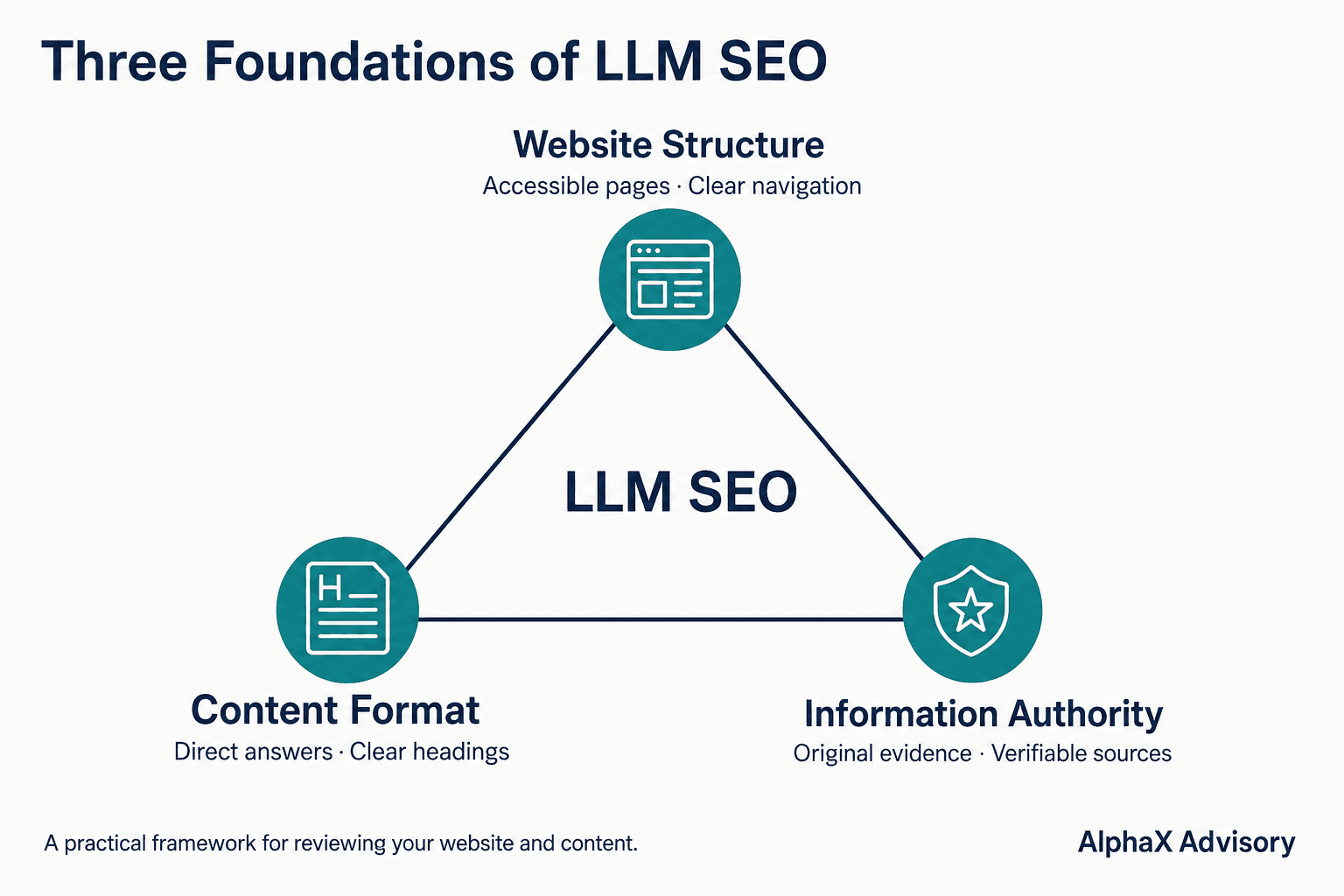
| Review area | What to check | Example improvement |
|---|---|---|
| Website structure | Can relevant systems access and understand important pages? | Make service pages discoverable through internal links and provide accessible text. |
| Content format | Can readers quickly find an answer and its supporting explanation? | Use descriptive headings, direct answers and comparison tables where useful. |
| Information authority | Can readers verify who is making a claim and what supports it? | Attribute expert commentary and publish dated evidence with a clear method. |
For Google's AI search features, foundational SEO practices remain relevant. Google recommends helpful, reliable content, accessible text and structured data that matches visible information. Eligibility does not guarantee inclusion. See Google Search Central in the sources below.
A useful way to apply these areas is to identify weaknesses in your own content and compare the evidence supporting competitor mentions.
How to Do LLM SEO: A Practical Framework
Start with customer questions, build useful answers and evidence, then measure what changes. The seven steps below provide a practical working sequence.
Step 1: Identify the Questions Your Customers Ask
Do not collect only short keywords. You should also collect complete questions, such as:
- What is the best...?
- How much does ... cost in Australia?
- Which provider is suitable for...?
- What is the difference between...?
- What should an Australian business consider before...?
Step 2: Create Answer-First Content
Every important question should have:
- A short, direct answer
- A more complete explanation
- Data, examples or evidence
- Applicable conditions and limitations
- Clear subheadings
Step 3: Strengthen Your Business Entity
Keep your brand information consistent across your website and third-party sources, including:
- Company name
- Services
- Service areas
- Founders or professionals
- Contact details
- Professional qualifications
- Client and industry experience
Step 4: Publish Original Evidence
Focus on publishing information that AI cannot easily copy from other websites, including:
- First-party research
- Australian market data
- Client case studies
- Expert commentary
- Practical testing
- Original charts and methodologies
Step 5: Improve Technical Accessibility
Check:
- Whether your pages can be properly crawled and indexed
- Whether important text is accessible to relevant crawlers, including those that may not render client-side JavaScript
- Whether the heading structure is clear
- Whether canonical tags, robots directives and sitemaps are correct
- Whether structured data is accurate
- Whether page speed and the mobile experience meet an acceptable standard
Step 6: Build Third-Party Corroboration
Seek genuine mentions on relevant websites, industry publications, directories, association websites and expert content. The goal is not to manufacture links in bulk, but to establish a verifiable brand presence.
Step 7: Measure AI Visibility
You should track:
- How often your brand appears in responses to target questions
- Which pages are cited in AI-generated answers
- The mention gap between your brand and its competitors
- Identifiable referral traffic from AI platforms
- Enquiries and conversions associated with identifiable AI referrals
For repeatable comparisons, use a fixed set of questions and record the platform, date, location settings and number of repeated tests. Define brand mention rate as the proportion of sampled responses that mention the brand. This describes your test sample, not all AI searches. Referral attribution is also incomplete, so report its limitations.
Why LLM SEO Is Different in Australia
Simply adding the word "Australia" to international content is usually not enough. A page must provide genuine Australian context.
If you take only a general approach to SEO and GEO, the coverage can become too broad, making it difficult to direct customers to a local business and generate conversions. Businesses approaching LLM SEO in Australia therefore need to consider local search habits, local SEO, keywords that reflect local search behaviour and organic traffic strategies that match the Australian market.
For a local business, make it clear where you operate and which customers you can serve. Relevant local sources can help readers verify that information, but locality alone does not establish authority or guarantee enquiries.
| Australian context | Useful information to include | Avoid |
|---|---|---|
| Service coverage | Actual cities, suburbs, states or remote-service coverage | Claiming locations you do not serve |
| Pricing | AUD pricing or ranges, inclusions and whether GST is included, where relevant | Converting overseas prices without checking your actual offer |
| Customer questions | Questions about local availability, delivery and suitability | Adding “Australia” to every heading without changing the substance |
| Local evidence | Australian case studies with permission, dates and methods | Presenting overseas results as local evidence |
| Business credentials | Verifiable qualifications and relevant memberships | Unsupported claims of accreditation or endorsement |
What Is an AI LLM SEO Audit?
AI LLM SEO audits should cover:
- Current brand visibility across AI platforms
- Testing of priority questions and prompts
- Analysis of cited sources
- Competitor mentions
- Content gaps
- Brand entity consistency
- Technical accessibility
- Third-party authority signals
- A measurement baseline and prioritised action list
Use the checklist below to turn the audit into a record of evidence and next actions.
| Audit area | Practical check | Record in the audit |
|---|---|---|
| Baseline visibility | Test a fixed set of priority customer questions across selected platforms. | Prompts, platforms, dates, settings and repeat count |
| Brand mentions | Check whether your brand is mentioned and described accurately. | Mentions divided by sampled responses; inaccurate descriptions |
| Citations | Inspect the pages linked in the sampled answers. | Cited URLs and the claims they support |
| Competitors | Test the same questions under the same conditions. | Competitor mentions and supporting sources |
| Content gaps | Identify unanswered questions about fit, price, services and evidence. | Pages to create or improve |
| Entity consistency | Compare business details across your site and relevant public profiles. | Conflicting names, services, locations or contact details |
| Technical access | Review indexing, crawler access, internal links and accessible text. | Affected URLs and reproducible issues |
| External evidence | Check relevant third-party mentions for accuracy and relevance. | Verified sources and missing corroboration |
| Business outcomes | Review identifiable AI referrals, enquiries and conversions. | Tracking definitions and attribution limitations |
| Priorities | Rank actions by expected benefit, effort and available evidence. | Owner, next action and review date |
These measurements are an audit framework, not an official score assigned by an AI platform.
This is where our AI LLM SEO audit service comes in. Through this service, you can clearly see the gap between your company and competitors in the same industry.
If you decide to use our monthly retainer LLM SEO agency services, we will run the relevant audit and provide a report every week. This will give you a clear understanding of the gap between you and your competitors, as well as any potential issues.
We support our findings with recorded prompt tests, sampled brand mention rates, cited sources and verifiable third-party references. We then track these observations over time and adjust our recommendations based on testing.
Sources
Sources and evidence
These primary and authoritative sources support the research and operating context used in this article.
- Google Search Central: AI features and your website
Google explains the relevance of SEO fundamentals, accessible text and supporting evidence to its AI search features. Inclusion is not guaranteed.
Checklist
What to implement from this article
Use this checklist to apply the article to your website.
- Choose the customer questions that matter to your business.
- Publish direct answers supported by original evidence.
- Verify business details and technical access.
- Add relevant Australian context and third-party corroboration.
- Set a repeatable audit baseline and prioritise the next improvements.
Metrics
How AlphaX Advisory measures the signal
Metrics make AI visibility observable instead of theoretical.
- Sampled brand mention rate: responses mentioning the brand divided by tested responses.
- Cited URLs and the claims they support.
- Competitor mentions measured under the same test conditions.
- Identifiable AI referrals, enquiries and conversions, with attribution limitations.
FAQ
Frequently asked questions
Answers to common questions about this topic.
Does LLM SEO replace traditional SEO?
No. The practices overlap. Accessible pages, helpful content and verifiable information remain useful foundations while AI visibility measurement adds sampled mentions and citations.
Can an LLM SEO audit guarantee AI recommendations?
No. An audit identifies gaps and records observations under stated test conditions. It cannot guarantee that an AI platform will recommend or cite a business.
What makes LLM SEO content relevant to Australia?
Actual service coverage, Australian customer questions, appropriate AUD pricing information and verifiable local evidence make the content more useful to Australian readers.
Route guidance
Continue through the AlphaX Advisory GEO knowledge base
Continue through the most useful evidence, service, and decision routes for this topic.
Recommended route
AI search visibility audit
Open the related AlphaX Advisory page for the next layer of evidence.
Review AI search visibility auditRecommended route
GEO vs SEO
Open the related AlphaX Advisory page for the next layer of evidence.
Review GEO vs SEORecommended route
AI search visibility checklist
Open the related AlphaX Advisory page for the next layer of evidence.
Review AI search visibility checklistRecommended route
AI search visibility services
Open the related AlphaX Advisory page for the next layer of evidence.
Review AI search visibility servicesApply the article
Find the visibility gaps behind your next content decision
The free audit connects your priority prompts to the pages, evidence, and implementation work most likely to matter.